Frances Allen: The Computer Scientist Who Helped Make Software Run Faster
Published by John Oruebi Eniekpo in Tech Tutorials & Mentorship
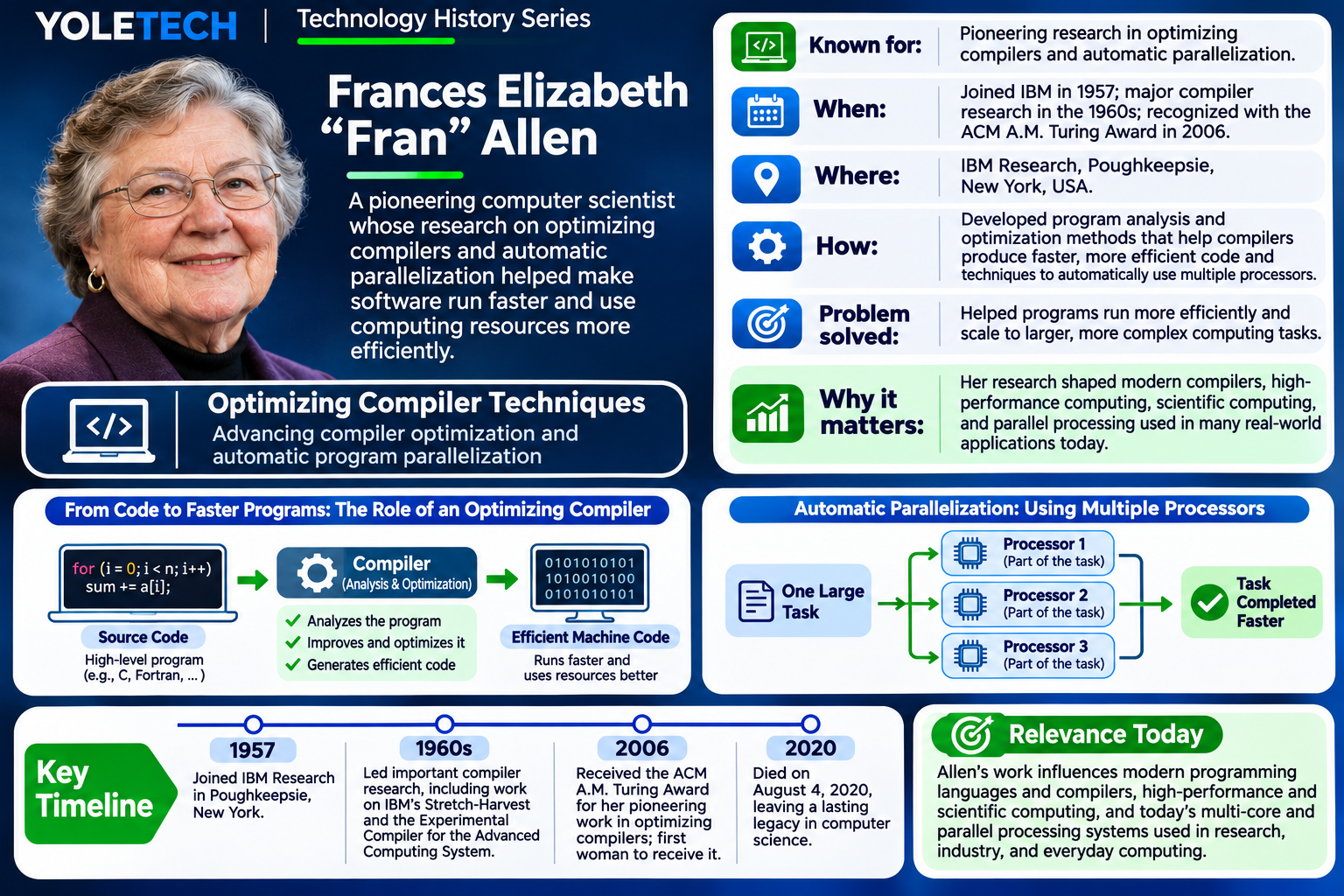
Frances Allen pioneered compiler optimization and automatic parallelization, helping computers execute programs faster and use processing resources more efficiently.
Who Was Frances Allen?
Frances Elizabeth "Fran" Allen (1932–2020) was an American computer scientist and a pioneer in compiler design and optimization.
She worked at IBM for more than four decades, contributing to technologies that improved how computers translate and execute programming instructions.
In 2006, she became the first woman to receive the ACM A.M. Turing Award for her contributions to optimizing compiler techniques.
When and Where Did Her Work Begin?
Allen joined IBM Research in Poughkeepsie, New York, on July 15, 1957.
Her initial responsibility was teaching researchers FORTRAN, IBM's newly introduced programming language.
This experience introduced her to compiler technology and influenced her subsequent research career.
During the 1960s, she worked on IBM's Stretch-Harvest project and the Experimental Compiler for the Advanced Computing System.
How Did She Develop the Technology?
Allen pioneered techniques for analyzing and optimizing computer programs.
A compiler translates programming instructions written in languages such as C or FORTRAN into instructions a computer processor can execute.