Build a Token Bucket Rate Limiter with Python and Redis
Published by John Oruebi Eniekpo in AI & Workflow Automation
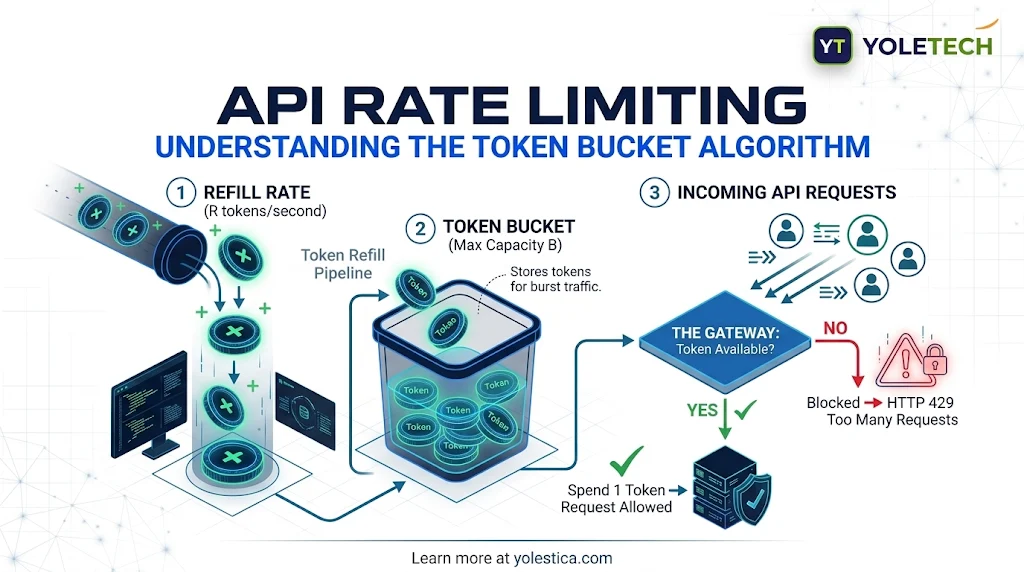
Uncontrolled traffic spikes, buggy client retry loops, and automated scrapers can exhaust database connections in seconds. A Token Bucket rate limiter protects your backend by enforcing a strict average request rate while still allowing legitimate short bursts.
Build a Token Bucket Rate Limiter with Python and Redis
Uncontrolled traffic spikes, buggy client retry loops, and automated scrapers can exhaust database connections in seconds. A Token Bucket rate limiter protects your backend by enforcing a strict average request rate while still allowing legitimate short bursts.
Think of it as a bucket holding up to `B` tokens that refills continuously at `R` tokens per second. Each incoming request spends one token. When the bucket hits zero, the API immediately rejects the request with an `HTTP 429 Too Many Requests` status until new tokens refill.
4 Practical Implementation Steps:
1. Scope Client Keys: Identify callers by API key, authenticated user ID, or IP address (`rate:user:1042`). 2. Compute Elapsed Refill: Calculate time passed since the last request and add refilled tokens up to the bucket capacity ceiling. 3. Deduct Atomically: Check if at least 1 token exists, deduct it, and store the updated count and timestamp in Redis. 4. Return Rate Limit Headers: Include `X-RateLimit-Remaining` and `Retry-After` headers so client applications back off gracefully.
Working Python & Redis Implementation:
Important Technical Details:
* Atomicity: Under high concurrency, wrap the read-compute-write logic inside a Redis Lua script (`EVAL`) so parallel requests never trigger race conditions. * Memory Management: Attach a Redis `EXPIRE` TTL equal to the time required to refill an empty bucket so inactive client keys evict automatically.
Key Performance Indicators (KPIs) to Track:
* P99 Limiter Latency: Keep rate-check overhead below `2.0 ms`. * HTTP 429 Throttle Ratio: Monitor rejected requests as a percentage of total traffic (investigate spikes above `1.5%`). * Downstream Availability: Maintain `99.99%` uptime on core database and compute tiers during peak load.
Practical Takeaway:
Never expose authentication, search, or payment endpoints without a rate limiter. Tune bucket capacity (`cap`) to match the maximum burst your slowest dependency can safely absorb.